


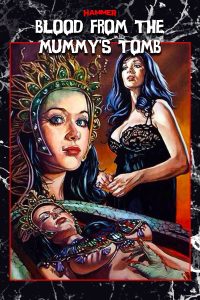
 In 1971 Hammer embarked on their fourth and, as fate would have it, final mummy film. As with the previous three it would be a stand-alone narrative rather than part of a series of sequels but, unlike them, mark a very definite departure from the usual formula.
The studio’s first chapter The Mummy (1959) borrowed the title of Universal’s initial 1932 outing in the genre with Boris Karloff as the resurrected Egyptian Im-Ho-Tep, but actually remade their 1940s mummy movies featuring the reanimated bandaged revenant Kharis as originally played by Tom Tyler and then Lon Chaney Jnr.
In 1959 Hammer put Christopher Lee into the cloth feet of Kharis for a repackaging of the best plot elements from the Universal films, and it proved successful enough for a second. But with Lee no longer interested in made over monster roles, Hammer opted for a non-sequel follow up The Curse of the Mummy’s Tomb (1964) with Dickie Owen. Though original in story and characters, its elements were all too familiar with Egyptian curses and a vengeful killer mummy.
This standard plot was redressed and replayed again for The Mummy’s Shroud (1967), with stuntman Eddie Powell given the starring part as yet another bandaged menace personally despatching anyone involved in the desecration of its tomb. Though the film itself is rightfully well regarded, three outings had rendered the formula decidedly tired.
In fact by the onset of the 1970s Hammer was seeking new blood in more ways than one. Studio head James Carreras was not only after fresh ideas but brought in producers from outside the Hammer family to come up with them. One of these was American publicist Howard Brandy who wanted to move into producing, and had acquired the movie rights to a novel by Dracula author Bram Stoker, The Jewel of Seven Stars (1903).
The story opens with barrister Malcolm Ross being called to the home of Margaret Trelawney where he finds Scotland Yard detectives already on the scene. Margaret’s father, Abel Trelawney, an archaeologist of Egyptology, has been found unconscious and his left arm apparently torn by huge claws. It becomes suspected that the assailant was targeting Trelawney’s safe which contains Egyptian relics.
Eugine Corbeck arrives to reveal the relics belonged to the ancient Queen Tera, who planned to reincarnate herself with the Jewel of Seven Stars. He and Trelawney retrieved the items from the Valley of the Sorcerer during which some of the expedition party were found strangled, apparently by a seven fingered hand. Though Tera is mummified, one arm is well preserved but missing its hand.
During these events, Trelawney’s pregnant wife back in England had died while giving birth to the infant Margaret. As she grows up, her resemblance to Tera does not go unnoticed by her father.
Trelawney regains consciousness and has Margaret show Ross her birthmark, a thin jagged line around her wrist. He has little doubt that she is linked to Tera and proposes a “great experiment” to facilitate Tera’s plans for rebirth. Ross joins Trelawney, Margaret, Corbeck and Dr. Winchester as they relocate to a house in Cornwall.
Trelawney ceremonially uses the Jewel of Seven Stars as the basis of the experiment and Tera’s power becomes unleashed, with smoke and flashing lights overcoming the participants. Ross survives to tell the tale, but what of Margaret? That depends on which edition of the novel you read.
In the original 1903 publication, Margaret dies in what proved to be a shocking conclusion for many readers. The 1919 edition featured a substitute ending where Margaret survives and marries Ross. Whether Stoker himself rewrote the closure to ensure reprint, or whether it was posthumously done by another unaccredited scribe remains a moot point.
What is generally accepted is that The Jewel of Seven Stars failed to match the success of Dracula partly because it is not as well written. The narrative is dialogue heavy at times and padded in places, which is very much at odds with its concise structure of time and space.
But it is an intriguing story with its theme of female empowerment becoming destabilising and destructive. The relationship between Ross and Margaret/Tera is one of love and horror which, in Stoker’s society, undermines the natural order of things.
With its plot of Egyptian curses and ancient evil persisting, it is surprising The Jewel of Seven Stars had not been filmed for the cinema earlier. Along with Frank Belknap Long’s short story A Visitor from Egypt (1930), Stoker’s novel was arguably an influence on Universal’s 1932 The Mummy and an archetype for the whole genre that followed. But it was a long wait before a legitimate screen version arrived, and two turned up around the same time.
The first adaptation was for television in 1970 as part of the ITV anthology series Mystery and Imagination. Re titled The Curse of the Mummy, the studio bound production was limited to 80 minutes running time, streamlining the Stoker novel into a more concise drama both in terms of plot and cast. Thus Malcolm Ross, a fledging lawyer in the original text, becomes a Doctor in this version enabling his role to double both as investigator and Trelawney’s medic. Similarly, the action is confined to Trelawney’s town house, the experiment being conducted in its basement to reduce both running time and cost of extra sets.
Writer John Russell Taylor opened with a new introduction in which Margaret (Isobel Black) dreams of being Tera in ancient Egypt and stabbing one of her priests (Patrick Mower, who also plays Malcolm Ross). This scene replaces the opening of the novel in which Ross is awakened from his slumber to receive the summons from Margaret.
The second major departure is that Tera’s body is not mummified but her whole being perfectly preserved. This lent the play visual confirmation of Margaret as the double of Tera, promoting her link with the ancient queen from inference to probability. The likeness also gives Corbeck a shock when he first sets eyes on Margaret, giving the tale a more dramatic jolt.
The main body of the narrative remains fairly consistent with Stoker’s plot, though the ending departs from both editions of the novel. Margaret lives, but on the night before their wedding day she appears before Ross dressed as Tera, the look in her eyes suggesting this may not be Margaret anymore.
The production held well as a stage play for television, maximising its use of limited location and sets. The appropriately named Isobel Black delivered a strong sense of wide eyed darkness, especially in her portrayal of the grey eyed Tera herself, while Patrick Mower pulled off an acceptable matinee idol performance. It gave the Bram Stoker story a satisfactorily test run for the Hammer adaptation the following year.
With the greenlight given James Carreras put his son Michael in charge of the production, as he was in the process of taking over from his father as studio head. Also keen for new talent, he and Howard Brandy brought screenwriter Christopher Wicking on board to adapt the novel, having cut his teeth on American International’s The Oblong Box (1969) and Cry of the Banshee (1970).
For the director’s chair, Gordon Hessler and Peter Duffell were both approached before Wicking suggested Seth Holt who accepted the task. Holt previously directed Scream of Fear (1961) and The Nanny (1965) for Hammer but this would be his first actual horror film, and for which he would deploy his preference for tension over shock.
Like the TV version, it was decided Bram Stoker’s original title was not horror sounding enough and Christopher Wicking later revealed how Hammer literally took all the words associated with the mummy genre and forged them into Blood from the Mummy’s Tomb. Although Tomb had already been used for two mummy films previously, Blood had not, while from the suggested a menace originating from an Egyptian burial chamber but not necessary in the form of its resident mummy.
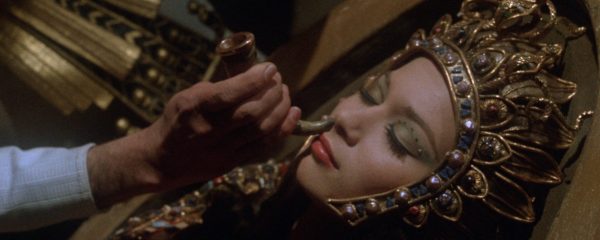
As with the TV version, Wicking’s version opens with Margaret (Valerie Leon) in bed dreaming of ancient Egypt. This time she dreams of an unconscious but still breathing Queen Tera (also Valerie Leon) being entombed, the priests cutting off her hand that wears the Jewel of Seven Stars and feeding it to the jackals outside. However, her power still lives as the animals have their throats mysteriously torn out and the hand crawls through the sand with a life of its own. Sealing the tomb, the priests are attacked by a supernatural force and their throats also ripped.
Margaret awakes from the dream screaming, her father, Julian Fuchs (Andrew Kier), rushing in to check she is all right and it is confirmed this is a nightmare she has suffered before. Neither of them is aware that their house is being watched from across the road by Corbeck (James Villiers) from an empty property he is renting.
Next morning Fuchs presents his daughter with the red ruby ring for her imminent birthday, telling her to wear it but not mentioning it had belonged to Tera. When later showing the ring to her boyfriend Tod Browning (Mark Edwards), he realises it came from the expedition to Tera’s tomb that her father had lead years before.
Tod decides to show the ring to one of the other expedition members, Geoffrey (Hugh Burden). It is the first time Geoffrey has met Margaret and her resemblance to Tera sends him into a fit. When later visited by Corbeck, it becomes clear he believes that Margaret being the double of Tera is no coincidence and part of the ancient queen’s plan.
While spending the night with Tod, Margaret dreams of when her father’s expedition uncovered the perfectly preserved body of Queen Tera, the team including Corbeck and Geoffrey, along with Berigan (George Coulouris) and Helen Dickerson (Rosalie Crutchley).
At the moment Fuchs discovers Tera’s name inscribed on a ring found on her severed right hand, his wife back home dies giving birth to Margaret. Meanwhile at the tomb, Tera’s severed stump begins oozing blood, to which Corbeck smiles.
Back in the present day, strange events begin to occur which seem linked to Margaret’s birthday and the fact she now wears Tera’s ring. Helen Dickerson sees the image of the Seven Stars in her crystal ball while Berigan is attacked by a force unseen and his throat ripped, the cobra statue he brought back from the tomb then disappearing.
Professor Fuchs himself is attacked by an invisible power and ends up bedridden for a while, Tod and Margaret discovering Tera’s body in a recreation of her tomb in Fuchs’ basement. During a secret meeting with Corbeck, he reveals to Margaret that Tera is preparing to return to the world of the living and requires the sacred relics kept by the expedition members. He believes her to be beyond good and evil with power over death that they can harness.
Margaret’s personality becomes divided between her own and the grip of Tera as she sets about retrieving the remaining relics from the other expedition members, who die in similar circumstances to Berigan. As Margaret battles with Tera’s influence, Tod himself becomes a victim of her murderous power.
With the relics assembled, Corbeck’s great experiment commences in Fuchs’s basement but goes out of control when Margaret and her father try intervening. Both Corbeck and Fuchs are killed, while Margaret battles hand to hand with the now revived Tera before stabbing the ancient queen and sending her back to death.
Rendered unconscious, Margaret is unable to escape when the basement caves in and she is buried under the rubble. Next we see her in a hospital bed unconscious and swathed in bandages with only her eyes on show, her identity and those of the deceased found at the scene listed as unknown. As the credits roll, her eyes open wide as she mumbles helplessly.
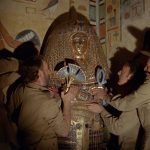
As with the television version, the closure of this adaptation is ambiguous. Is the fact we can no longer see her face and she is classed an unidentified patient suggesting that Margaret’s own identity is now lost? This begs the further question of whether is it Tera herself seeing through those staring eyes. If so, then the ancient Egyptian queen has effectively become a mummy.
In fact Wicking’s screenplay moves further away from the Stoker text than the TV version, updating to a contemporary setting and opened up with additional locations and characters. The members of Fuchs’s archaeological party are not killed at the time of the original expedition, but remain alive and each in possession of artefacts retrieved from Tera’s tomb until needed for her resurrection. Tera’s dominion is already malevolent and her full awakening will be the completion of the process.
For this purpose Wicking decided that Stoker’s story needed villainy of a human agency and recast Corbeck as a shady, ambitious schemer, determined to exploit Tera’s power and persuading Margaret to assist him. It is a role that actor James Villiers clearly relished delivering in a persona reminiscent of George Sanders, particularly his memorable line “Well, the meek shall not inherit the Earth. They wouldn’t know what to do with it.”
Another curious innovation is naming Margaret’s boyfriend Tod Browning after the classic Hollywood horror director who gave the world the first official film version of Dracula (1931) with Bela Lugosi. Presumably it is the Stoker connection Wicking is referencing as Browning never made a mummy film, but then this production does not actually have one.
Like the television version, Tera’s body is portrayed as perfectly preserved rather than mummified. Apart from highlighting the link with Margaret it suggests the ancient queen is in suspended animation rather than fully dead, Valerie Leon’s feline looks projecting a strong presence even from Tera’s inert state. It also enabled the added dividend of being able to put Leon in an even more revealing costume.
But the most interesting departure Wicking makes is from the Hammer tradition of a patriarch figure saving the day. The usual pattern was to have an older male character step in and save the younger protagonists from the evil with which they have inadvertently become involved or unleashed. Like Shandor in Dracula – Prince of Darkness (1966) or Duke de Richleau in The Devil Rides Out (1968), the elder lead uses the wisdom of his knowledge to vanquish the threat, restore balance and therefore order, and thus re affirming their patriarchal authority.
Perhaps being a young writer at the time, Wicking deconstructed this approach in having the elder characters instigate the release of destructive forces through their own misguided sense of authority, and their assumed right to take possession of treasures that do not belong to them. He further reverses things by having it fall on the younger protagonist, Margaret, to undo their damage and save the day.
More importantly, the fact a woman becomes the narrative’s sole survivor and the one who takes up the sword to climatically despatch the evil also represented a breakthrough. This task could have been the prerogative of the heroic male lead, but Wicking undermined this tradition by killing him off earlier.
The film was skilfully lensed at MGM-EMI studios and locations around London by cinema photographer Arthur Grant, with particularly memorable shots of astrological foregrounding to suggest the hand of inescapable fate ultimately controlling events. From opening titles set within the vastness of space to visual representations of the aligning seven stars, permeating throughout the film as reflections in a crystal ball, lights on a carpet or watching down from the ominous night sky.
In handpicking the cast, Peter Cushing was an early choice for Margaret’s father, now called Julian Fuchs, and the role written with him in mind. Margaret herself was to have been played by Deborah Grant, but James Carreras pushed for Valerie Leon who had come to public attention as the tall, predatory dominatrix in the now legendary commercials for Hai Karate aftershave.
But then the filming schedule was tragically marred by two events which have cemented its legend as a jinxed production. Peter Cushing had to bow out after a day’s filming due to his wife, Helen, becoming seriously ill. She sadly lost her life and obviously there was no way the grieving actor could return and resume at that point.
Hammer had no choice but to recast the part of Julian Fuchs and immediately turned to Andrew Keir who had given a memorable performance as Father Shandor in Dracula – Prince of Darkness. The fact that he effectively replaced Cushing’s Van Helsing in that film may have partly inspired the choice and Keir was fortunately available to step in at short notice. He admirably succeeded in putting his own stamp on the character, even though Fuchs is invalided and side-lined for much of the film.
But then the production was hit by a further blow when director Seth Holt suddenly died from a heart attack during the final week of shooting. Production was suspended and Holt given a memorable send off by the studio who loaned the funeral cortège one of the horse drawn hearses used in the Dracula films, complete with black draping and plumed horses.
Having buried their director in style, Hammer set about getting the project finished while the cast were still available. Michael Carreras decided to step in and complete the directorial duties himself, being the quickest and easiest he could get. Besides, he had previously done the same on The Lost Continent (1968) after the original director, Leslie Norman, left the production.
Holt had not left any notes to go on and had worked without an editor, which meant the already shot footage had not been documented. Consequently, Carreras had to study what was already in the can and work out which scenes they needed to complete. He found, or at least claimed that Holt’s material did not quite cut together and made a couple of alterations to the storyline structure during the editing stage.
This production detail has prompted more analytical reviewers to comment on perceived differences between the two directors, particularly in the acting style extracted from their cast. Indeed, Valerie Leon later said she did not receive as much direction from Carreras as she did from Seth Holt, and was upset he did not give her the time off to attend Holt’s funeral which soured their working relationship.
However it is not unusual for a movie to employ secondary directors for scenes where the primary director is not available (usually when there is a second unit shoot), and what Carreras did was a week’s completion job on a production nearly finished anyway. Doubtless there may well be some identifiable inconsistencies for those looking for them, but the finished assembly holds together well enough for the rest of us.
One glaring inconsistency that did slip through into the documented credits and opening titles was the source novel stated as being Jewel of the Seven Stars, the definite article having somehow slipped anchor and drifted. It is of course The Jewel of Seven Stars, but has since popularly become known and referred to by the Hammer quoted version of the title.
The film was given UK release by MGM-EMI and granted a prestigious premier at London’s National Film Theatre as part of a retrospective of Hammer films curated by the British Film Institute. This was an illustrious occasion as it finally marked Hammer’s cultural contribution to the cinematic arts, and not the exploitive lowbrow studio that critics often accused it of being. Just a pity that, like all dead good poets, this recognition came just as the original Hammer was nearing the end of its time.
Blood from the Mummy’s Tomb went on release as part of a double feature with Dr. Jekyll and Sister Hyde (1971), American International Pictures handling the US distribution. While deemed a success, it was the last foray into the genre of Egyptian curses and mummies that Hammer would undertake.
The film did help cement the career of Valerie Leon, making full use of her statuesque figure with a near naked Tera and a heaving bosomed Margaret with a taste in low cut negligees. However, a body double was brought in for a nude scene as Leon refused to go naked for the camera.
But apart from her physical attributes, Leon delivered a commendable performance which inhabits both the characters she plays with seamless transition. Particularly memorable is the haunting scene where Margaret sleepwalks down to Tera’s body in the cellar, her black night gown billowing in the wind to the haunting strains of Tristram Cary’s evocative music score, before effectively meeting herself.
It is a pity Leon was not granted further lead roles, but she did enjoy appearances in three other classic British film franchises, including six Carry On movies and up against Peter Sellers as Inspector Clouseau in Revenge of the Pink Panther (1978).
But it is her roles in two James Bond films for which she is mainly remembered, having scored the accolade of appearing with both Roger Moore in The Spy Who Loved Me (1977) and Sean Connery in Never Say Never Again (1983). She later admitted preferring the Connery outing as she actually got to bed his 007, as opposed to just handing Moore the key to his hotel suite and making gooey eyes at him.
Following this project, Hammer did look at a further Bram Stoker adaptation with a proposed portmanteau feature Victim of his Imagination, utilising some of the writer’s short stories. Although Christopher Wicking worked up a script initially drafted by Don Houghton, the project got no further.
Wicking did go on to write Demons of the Mind (1972) and To the Devil a Daughter (1976), and would undoubtedly have scribed further Hammer features had the studio not shut up shop. One cannot help wondering if one of these may have been the Bram Stoker novel, The Lair of the White Worm (1911), before Ken Russell got his hands on it.
But at least the profile enjoyed by Blood from the Mummy’s Tomb drew attention to the fact that there were Stoker novels apart from Dracula ripe for filming, and it was not long before The Jewel of Seven Stars came to the attention of Hollywood.
The 1980 adaptation, The Awakening, may have enjoyed a bigger budget than the Hammer film and boasted the presence of Charlton Heston, yet has come to be regarded as its poorer cousin. The cheekily titled Bram Stoker’s Legend of the Mummy (1997) went straight to video, but did well enough to warrant a sequel.
As a consequence The Jewel of Seven Stars is now the most filmed of Bram Stoker’s other novels, and will no doubt be mined again in the future. But time has proved the Hammer version a hard one to equal – let alone top – and deservedly remains one of the most highly regarded of the studio’s later output.
Words: Barry McCann


